Thursday, 20 January 2011

A Room with a View


I’ve mentioned before that we’re doing some major building work at our property, and that the builders are great craftsmen. But the person who has had the vision to bring everything together into a glorious whole is the architect, Olivier. He has a gift for transforming problems and crumbly, dark corners into wonderful spaces that, inside and outside, further enhance the beauty of this magical place.

Here’s one of those happy instances where it all comes together: the view from one of the windows in our guardian’s newly-restored cottage. The first time I walked in I thought, just for a moment, that there was a bright picture hanging on the wall, so beautifully is the view framed.

                                                                                 
 Beyond, in the rising hills to the east, the first shivers of the Alps heft the land further into the sky. There the fields are corded purple; forever that long ago summer when she scythed and bent with the other girls, the women and the elderly to pick lavender flowers for the perfume factory.
   Higher still the land is stubbled with sheep. They say that that each troop of sheep keeps the scents of its particular grazing land deep in its fleeces, so that its provenance can be established by what the nose detects in the matted, unwashed wool: thyme and dry rocks, acorn-mashed mud, slopes where the herb savory grows in abundance, the pollen of gentian fields, hollows where leaves rot with wind-blown spikes of lavender.  
           
                                                                                               from The Lantern

Monday, 17 January 2011

A brief encounter with Pierre Magnan


Of all the books set in France I’ve been reading, Pierre Magnan’s Innocence is one of the most atmospheric and mesmerizing. As dawn breaks over the hills of Provence in June 1945, a fifteen-year-old boy Pierrot stumbles across the body of a local Resistance hero. The man has been murdered. But Pierrot cannot resist looking through the dead man’s wallet – and finds a letter written on blue paper that will prove the key to illicit love and betrayal and revenge, and Pierrot’s own first experience of love with the passionate older woman Madame Henry.

In Pierrot’s awakening and loss of innocence, there are echoes of the Alain-Fournier classic Le Grand Meaulnes. It is a story recalled in maturity that yet yearns for what is past, both in the sense of love lost, and the idealism of youth.

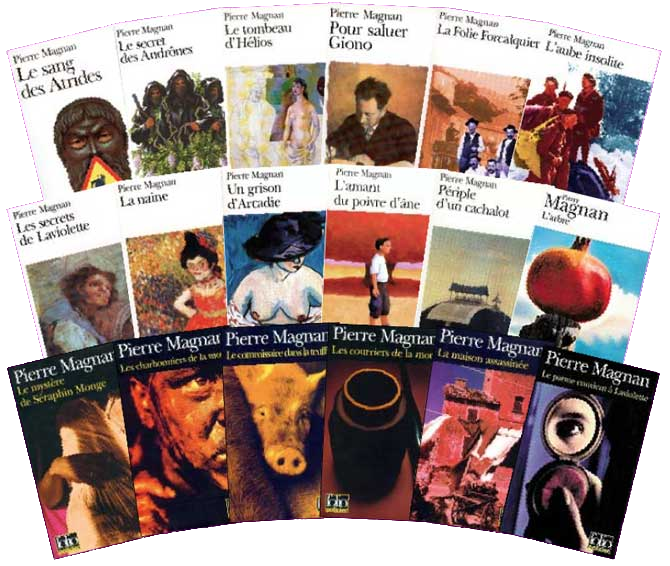
This Vintage edition is an excellent translation by Patricia Clancy. The French title is Un Grison d’Arcadie but I like the English title better.

So when I read in the newspaper La Provence last summer that Pierre Magnan was signing books at the festival of books at Grambois, a hilltop village over the Grand Luberon mountains from us, I had to go.

It was a swelteringly hot, still day. Grambois does look a little like the village on this cover, especially with the great plain below, indistinctly depicted at the top right of the picture. The Fete du Livre had attracted a good crowd and plenty of stalls full of old and new books. Pierre Magnan’s late mentor and friend was the great Jean Giono, and Giono’s daughter Sylvie was another respected guest in the village that afternoon.

Coshed by the heat, the crowd wilted under the trees and drank diabolo menthe at the bar. At around five o’clock the famous author appeared: a spry, merry gentleman in a large Panama hat and baggy white linen suit.

With more than thirty novels and memoirs under his belt, Pierre Magnan is now in his late eighties and the grand old man of Provençal letters. All his novels are set in the countryside around his home in Forcalquier and many of them are thrillers imbued with a fine black humour. He likes the dynamics of feuds and jealousy and pettiness, and clearly relishes a spot of vengeance.

His journey to success as a writer is thoroughly inspirational. He published his first novel L’Aube Insolite (Strange Dawn) in his twenties in 1946, to critical acclaim but modest sales. Three further novels went the same way. So he went to work for a refrigeration transport company for nearly thirty years, until a redundancy package gave him the time and security to write again. In 1978 he wrote the first in his acclaimed police procedural series featuring Commissaire Laviolette, won a literary prize, and never looked back.


It’s not often you get the chance to tell people face to face how much you’ve enjoyed and admire their work, so I got in line at the bookstall and took my chance as he signed the copy I’d bought earlier. What I wanted to say was how much I was struck by the way he had captured the mystery and yearning of Le Grand Meaulnes but that his novel was erotic in a way that Alain-Fournier, writing in 1913, could only have dreamed of publishing.

A distinct twinkle appeared in Monsieur Magnan’s eye as I pressed on regardless of the jostling cluster of elderly lady readers behind. He gave an eloquent shrug. ‘Ah, mais oui…’ He was curious enough to ask me where I came from, and wrote a sweet message in my book.

The queue grew restless. But, this being France, everyone knew there was a balance between their dislike of waiting and the importance of allowing the Artist to receive due praise. Even if it was coming from a slightly red-faced Englishwoman talking of matters that, not being French, she could surely know nothing about…  

Thursday, 13 January 2011

The Scent of Figs


The summer we arrived on our Luberon hillside, I would sit reading in the courtyard under the trees. As hot still days went by, a luscious scent began to creep and curl into my consciousness. It was a while before I realised that these sweet musky breaths were coming from the fig canopy above my head.

The perfume of figs ripening in the sun is intoxicating. Gradually I'd stop turning the pages of my book and, barely awake under the tree, let the fragrance work its magic. There were notes of grilled plums with sugar, a hint of coconut and balsam. A Levantine touch, too, of spices from the souk, and rich chocolate, dark and decadent.

Plenty of perfume houses have drawn on this blousy sense of indulgence that sings to the frankly rather greedy among us. The one I like best because it comes closest to my memory of those drowsy scented afternoons, is Fico di Amalfi from Acqua di Parma’s Blu Mediterraneo range.

But I'm determined to hunt down Diptyque’s Philosykos, which promises an appealing moss-earthy wood, with green yet creamy-sweet fig. And there’s also Figue Amère from Miller Harris with a hint of violet among the coconut and musk.

This photo of figs on a leaf was taken in November last year, the last few survivors of a late harvest. We returned to England in September and missed the waspy, bursting stage I wrote about earlier here. Last year all the fruit was weeks behind schedule because the winter was harsh followed by an unusually cool spring. So though we didn’t manage to eat many of them, the figs stayed on the branches until the end of August, sending out pulses of natural perfume.

Monday, 10 January 2011

The Calanques: jazzy blue


A short boat ride from Marseille or Cassis are the magical calanques, deep cliff inlets like small fjords. For all the photographs and artworks that abound, it’s not easy to find images that do justice to their pure beauty, austere in places and yet lush in others.

But Olivier Boissinot’s exuberant paintings of the calanques pulsate with the vivid blues and oranges of a day so hot everything seems reduced to primary colour, and the heat and light sharpen every line. The eye is drawn deep into the myriad blues, in contrast to the baked rusty soil, until you can almost feel the beat of summer just by letting the picture work.

Born in Aix-en-Provence, Boissinot makes his work all about colour, the vibrant relationship of each shade to the one adjacent. The result is celebratory: of place and mood.

Here (below) is his masterly evocation of the high Calanque d’En-Vau. It seems the characteristic black outlines of his trees and rocks capture the dizzying effect of the height above the sea and the unrelenting sun.


   The calanque was below us, such a long way down. I shivered, involuntarily. On one vertical drop human climbers scrambled like lizards, searching out holds in the scarred rock faces of the cliffs. Turquoise water shifted far below, sprinkled with silver flakes.   
                                                                                             From The Lantern

To discover more of Olivier Boissinot’s work, which includes his travels in Morocco and the jazz clubs of New Orleans, click here for his website.

Friday, 7 January 2011

Red rocks at Cassis


Anyone for an infusion of sunshine while all is rain and gloom? Here is Cassis on a summer’s evening: pastel stucco buildings along the waterfront; boats lined up in the marina. Dominating the eastern side of the bay, a medieval chateau-fort sprawls across the towering rock of Cap Canaille, which surrounds the town like a huge protective arm. As the sun sets over the sweetly curving harbor, the castle catches flame from the west, and burns blood-gold for up to an hour each evening.
                                                                                      
This classic old fishing village on the Provençal coast has a rather different feel from the internationally fashionable resorts like St Tropez further to the east. It’s much more relaxed and less crowded, though you’ll need to get up at dawn to park in August. The atmosphere is arty-bohemian, though leavened by the sailing crowds and families. This has always been a resort where the French themselves come on holiday.

It’s also a place for anyone who enjoys a good book trail, because among the foreign visitors down the years, there are plenty of stellar literary associations.

Virginia Woolf travelled here to be with her sister Vanessa Bell, Vanessa’s husband Clive Bell and her lover Duncan Grant in 1925, and wrote after spending her days wandering on flower-edged footpaths through the woods and tiny beaches amid red rocks: ‘No-one shall say of me that I have not known perfect happiness.” For the next few years it became a veritable Bloomsbury-sur-Mer.

It’s a wild, rocky coastline here, a far cry from the white marble and manicured lawns of the palaces near Nice, where we picture F Scott Fitzgerald and Somerset Maugham. This is closer both geographically and in spirit, to tough, earthy Marseille.

In the 1920s a desperately-ill D H Lawrence came to try to calm his tuberculosis at Bandol, yet another stop among so many increasingly frantic attempts to find a climate kind to his failing health. Katherine Mansfield came for the same reason. Aldous Huxley lived at Sanary-sur-Mer, another small seaside town – very pretty but not over-glitzed even now. Sanary would become the chosen place of exile for a group of German writers fleeing Hitler’s fatherland during the Second World War, most notably Thomas Mann.

A little further round the coast is Hyères, once home to Robert Louis Stevenson, and where Edith Wharton had a house for many years and wrote several novels, including The Age of Innocence. She also wrote the lovely lyrical poem In Provence, which begins:

Roofed in with creaking pines we lie
And see the waters burn and whiten,
The wild seas race the racing sky,
The tossing landscape gloom and lighten.

With emerald streak and silver blotch
The white wind paints the purple sea.

Wednesday, 5 January 2011

Roof tiles


We’ve got the builders in. Well, actually les maçons have been in for the best part of the last three years, attending to large structural cracks, the odd exploded floor and the restoration of a cottage for our guardian. This time, though, it’s the final phase. The old sitting room in the main house - where the ceiling helped by falling in of its own accord – will be a place of safety at last.

It’s an old property. There’s a wooden lintel over the door of the restored cottage that is carved with the date 1624, though no-one can be quite sure whether that’s real or a previous owner’s folly. But this place does demand respect for its history, and the builders and architect we chose are true craftsmen with great feeling for stones and tiles. When new foundations and structural walls are built to solid modern specifications, they are always re-clad in their old stones.

And so the roof will go back on, the old lichen-pocked tiles dressing the new watertight wood. In those circumstances, even the piles of roof tiles against the courtyard wall have an integrity that, to my mind at least, makes them into something close to a work of art. 


Saturday, 1 January 2011

Sunlight on Lavender


Some scents sparkle and then quickly disappear, like the effervescence of citrus zest or a bright note of mint. Some are strange siren songs of rarer origin that call from violets hidden in woodland, or irises after spring rain. Some scents release a rush of half-forgotten memories.  And then there are the scents that seem to express truths about people and places that you have never forgotten: the scents that make time stand still.
                                                                                             From The Lantern

A real taste of Provence to wish you Happy New Year, as there’s nothing like the promise of southern light and warmth to raise the spirits when January days can be dank and dreary.

Actually, bad weather, on a working day at least, can be a positive for writers of a certain disposition. Dark clouds and rain stimulate the imagination. The colours seem brighter in the mind, somehow. I’m content sitting at my desk knowing I’m not missing out on much outside, as I try to paint pictures in words.

A few years ago when I was reading everything I could about Lawrence Durrell for my novel Songs of Blue and Gold, I came across a telling exchange between him and the poet Dylan Thomas. However did Thomas manage to write in the grey gloom of winter in Wales, Durrell wanted to know. Surely he needed vivid colours and vibrant life around him for inspiration? Thomas replied that if he lived on Greek island, like Durrell, he would never get any work done; the grey helped him to see brightness better. I’m definitely with Dylan Thomas on that one.

Researching a book is something different, though. That’s the time to get out and about in the sun with a notebook; the time when life can seem pretty much ideal. Then, in my case, it’s back to England in winter to form the fragments, the odd details and observations, into some kind of whole. I’m just at that stage now with a new novel. New Year’s Resolution Number One: start writing!   

Related Posts Plugin for WordPress, Blogger...