Thursday, 6 February 2025

The Secretary: Women Talking review


As first reviews go, they don't get much better than this from Women Talking magazine. "With its rich historical detail, compelling characters, and a narrative that keeps readers on the edge of their seats, The Secretary is a standout addition to Cold War fiction. Deborah Lawrenson delivers a story that is both thrilling and deeply human, a tribute to unsung heroines who dared to make history from the shadows."

You can read the whole review HERE.

The reviewer Poppy Watt really understood this crucial aspect of the novel and my mother's real-life story: "Lawrenson’s portrayal of Lois is striking and refreshing. As a bright, ambitious woman navigating the male-dominated world of espionage, Lois embodies both vulnerability and strength. The story’s tension derives not only from the dangers of her mission but also from the complex gender dynamics of the time, where women like Lois were simultaneously vital and undervalued."


Thursday, 21 November 2024

The Secretary


At long last, my work in progress is on its way to publication, out February 28th, 2025. I'm loving the moody intrigue of the cover, entirely appropriate for the 1950s setting and story. I'll be posting much more nearer the release date but for now I will trail the blurb like steam and smoke from a locomotive train waiting to set off...

"A tense Cold War spy story set in Moscow in 1958, told from the perspective of a bright young working class woman recruited to MI6 at a time when men were in charge of making history and women were expendable."

Lois Vale is sent to Russia as a secretary at the British Embassy on a deep cover MI6 counter-intelligence mission to uncover the identity of another suspected traitor in the febrile era after the (real-life) defections of Burgess and Maclean. On the train journey to Moscow from Helsinki, Lois is approached by a mysterious Russian man who knows who she is. Her assignment is already potentially compromised.


Sunday, 3 January 2021

Work in Progress

Update: I'm still here, still quietly working away in these strange, unsettling times. I can't say I've worked all through last year, but I have a rough draft now of the hardest and most rewarding book I have ever attempted. Its scope has expanded though, and I now envisage a two-part work in the same volume. The first will be a fictionalised novella based on my mother Joy's diaries, set in Moscow in the late 1950s at the height of the Cold War. The second will be a memoir of her, and our experiences as a family - what happened next, in other words.

My thinking is that this might seem odd at first glance, but actually could be very satisfying. And sometimes writers have to try new formats, surely, or all books would conform to the same dull template. This is the idea I'm currently working with, anyhow. It's a way to avoid compromising the drama of a spy story based on real, known events, in particular the continuing enigma of Kim Philby before his unmasking as a Soviet spy, while also examining the personal price paid for what she herself called "an interesting life".

There's a true romance in the fiction, too. It was in Moscow that my mother met my father. Their tales of their dates trailed by the KGB became part of the fabric of our family history. Some of their adventures sounded fantastical when I was growing up, but research has proved it all to be true, and much more besides that I never realised. 

In the end, this personal memoir of her is a universal story about how families and their stories evolve; the narratives we thought we knew and understood, yet missed the point due to familiarity and mistaken assumptions, or lack of courage to ask, or lack of curiosity at a given time. And sometimes, secrets kept until the last.

A short extract from the first draft:

My mother never discussed any specific work she did. But I read and then carefully transcribed her diary for 1958 knowing what she had finally told me in her final years: that she had worked for MI6 and that “There were four of us who knew all the secrets” at the British Embassy in Moscow.

She would have had a natural aptitude for intelligence work. Despite her beauty, she was self-effacing almost to a fault, did not court attention and was irritated by those who did. She was analytical and patient, interested in psychology and sociology; her nature was self-sufficient and she had deep inner resources. 

Some people - perhaps most people - want to seem more than they are. Very few people are content being more than they seem – but Joy was one of them.

What was always clear was that the past was never all that far from the present. It resonated throughout my childhood. The war my parents experienced as children. The lucky near-misses in wartime bombings. The fateful meeting in Moscow. The Cold War. Kuwait. Peking. When they entertained, which was often when we were abroad, the talk was all of foreign postings and people and upheavals, political and personal. Communism. The Cultural Revolution. The grey oppression and underlying threat of Soviet Russia. It was a lot for a silent, observant child to take in. I would sit quietly, lest I be told to go out of the room, absorbing it all, as the tales rolled out of people who had disappeared, what had been tried to save them, or find them, or help them across a border, like the European nuns who had taught me and other international children at the Convent of the Sacred Heart, the last Catholic school in China.

When my sister and I were growing up, she made sure we knew that she thought satisfying careers for girls were far more important than finding husbands. Though in the long run, husbands and families were to be encouraged, they shouldn’t be considered until we were in our thirties and had had more experience of life. (When I married at 28, it was with a sense that I might have rather let her down.) It was typical of my mother that when I left school after taking Oxbridge entrance examinations in December, I found she had booked me a secretarial course starting in January. Her reasoning was simple: with typing and shorthand skills, I would be able to earn good money in the university holidays, and would always have something to fall back on. I did wonder, though, whether there was a subtext. She wanted me to understand that clever girls could forge interesting careers by careful choice of which typewriters to bash.

My parents in Moscow in January 1959, at the wedding of friends - Joy was a bridesmaid. They would marry later that year in London.


Wednesday, 1 January 2020

A new beginning


Happy New Year to any of my old faithfuls who still check in to this blog from time to time. My plans to switch to using the blog on my new website didn't quite come off, as I discovered that this one was more user-friendly after all (or maybe I just like what I know). So I plan to update this one more often this year.

The two Penelope Kite mysteries written with Rob under the nom de plume of Serena Kent will come out in paperback in the USA and Canada in February and March. But meanwhile, I have been playing around with a new solo novel, one I have wanted to write for several years but couldn't find the way in. I think I can see the path now, and have been doing some fascinating research.

The photo shows the heroine, my mother Joy, who passed away five years ago. Here she is in Moscow in 1958, at the Donskoi Monastery. She was working at the British Embassy, but what exactly was she doing there at the height of the Cold War? Her diaries tell us very little, though some of the entries contain a wonderful mixture of the exciting and the mundane, such as the contrast between two letters in the entry below. There are intriguing clues between the lines, some that make sense only to those who know the family stories. I see it as a novel about remarkable events never spoken about, mothers and daughters, and what we don't - or can't - know about those we love. Wish me luck!

Diary for Saturday, June 14 1958: Panic stations this morning with a lengthy Khrushchev letter to go out; four of us worked on it & it was ready in time; home late, only to dash out again on the Kremlin visit. Only I turned up & we had no guide; the museum & churches were quite interesting, but O so tiring – and the Gruesome Twosome weren’t receiving after 4. [Deborah's note: The "Gruesome Twosome" refers to Stalin and Lenin, who shared a mausoleum between 1953 and 1961. A nice example of my mother's dry humour.]

Joy came in for a cup of tea – we were perishing cold, and then I was quickly out again with Valerie to see “The Monte Carlo Story” with Dietrich & de Sica at America House. Enjoyed it very much; came straight home & managed to get my letter home written in bed.


Sunday, 27 October 2019

The joys of re-reading Mary Stewart


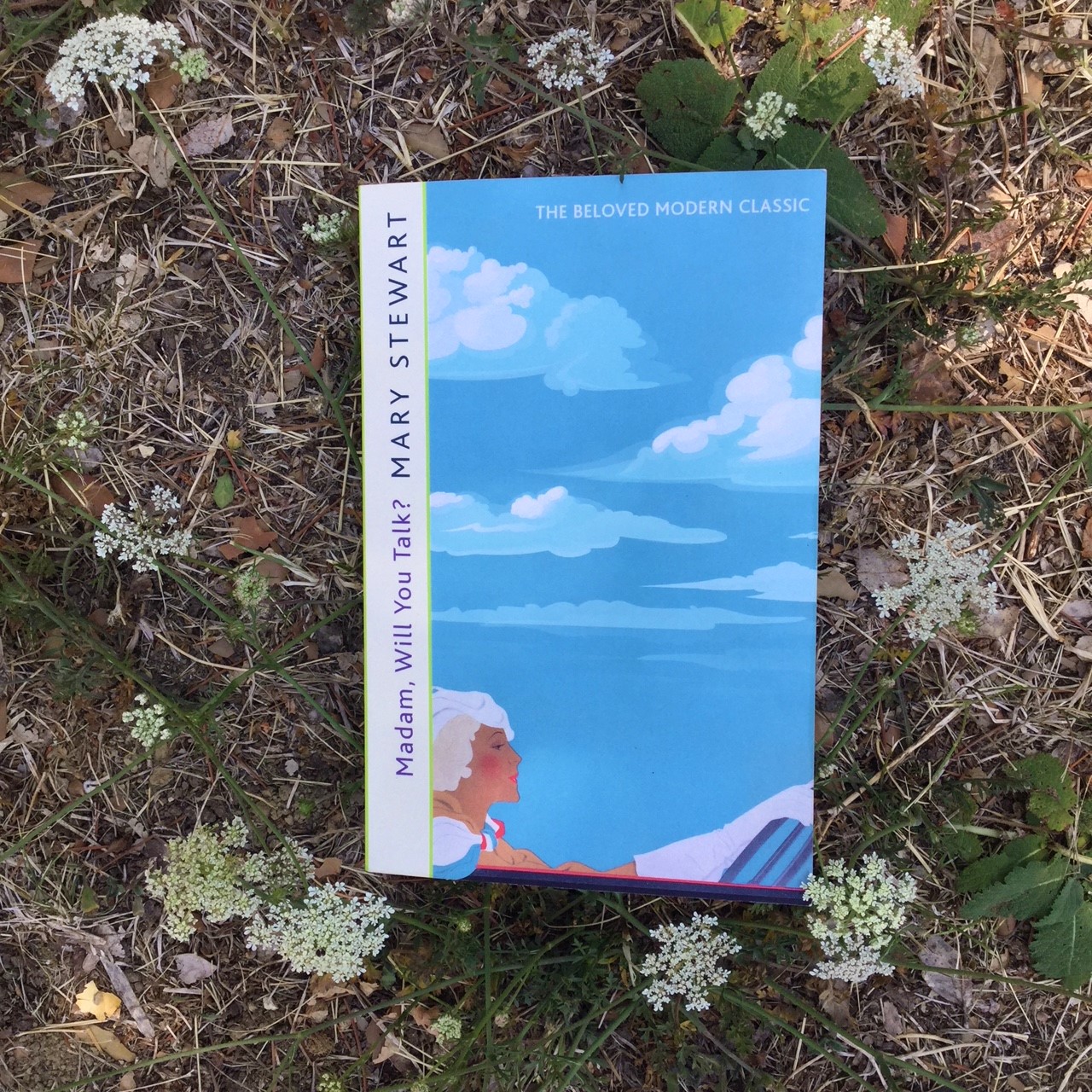
I love Mary Stewart’s romantic suspense novels: their sense of adventure and intriguing storylines, their strong-willed heroines, and most of all, their transporting settings. Her first, published in 1955, was Madam, Will You Talk?.

The narrative takes place around 1950, in a hot, dusty Provence where Roman ruins and stony, abandoned villages dominate the landscape. The Second World War still casts a shadow over the life of young widow Charity Selborne, whose husband lost his life flying RAF operations. On a summer motoring holiday through France with a friend and fellow teacher, Charity arrives at a small hotel in Avignon. Through Stewart’s lyrical descriptive prose, we feel her release and excitement at being in the balmy warmth of the south.

‘It was dusk when I set out, and the street was vividly lit. All the cafés were full, and I picked my way between the tables on the pavement, while there grew in me that slow sense of exhilaration which one inevitably gets in a Southern town after dark.’

This is the opening of a piece I've written for Perfectly Provence e-magazine. To read on, please hop over to Perfectly Provence on this link.

Friday, 22 March 2019

Blog move


After more than eight years on Blogger, I have moved my blog to my new website: https://www.deborah-lawrenson.co.uk/. It made sense to combine the two, especially as I no longer have the time to devote to writing posts, and it seems to me that there are diminishing returns from doing so. Naturally, I shall keep the archive here, as it's a record of the first publication of my books in the USA and an illustrated background to the stories.

Along with many other writers, I also enjoy using Instagram to interact with readers and booksellers, and I'd be delighted if you wanted to find me there: @deborah.lawrenson https://www.instagram.com/deborah.lawrenson/ and @serena.kent https://www.instagram.com/serena.kent/

Tuesday, 6 November 2018

The mystery of Penelope Kite's money


How can Penelope Kite afford to live in Provence? It’s been bothering some early readers of Death in Provence, and I think that’s great because it shows they are really trying to imagine her enviable new life in the sun. So while discretion usually applies to financial matters, I can’t allow the vexing question of Penelope’s money to overshadow the other mysteries in the books.

In fact, the answers are all there in the book – though subtly present, like all the best clues.

For more than twenty years, Penelope was married to David, a solicitor – later, partner – in a law firm that specialised in City of London transactions. In London “the City” is shorthand for banks and large companies, the US equivalent of “Wall Street”. It is quite conceivable that David would have earned several million pounds a year from the mergers and acquisitions and share issues he worked on, and equally possible that Penelope’s divorce settlement, after a long marriage, would have reflected this at £5-10 million.

Penelope owns a house in Esher, Surrey, an affluent suburb in leafy south-west London. It might have once been the family house. A spacious five-bedroom house in Esher currently costs £2-3 million, perhaps more.

But let’s err on the side of caution and say that Penelope bought a smaller house in Bolingbroke Drive after the divorce. Even that would most likely be worth more than £1 million. When she moves to the south of France, she rents it out. A quick look at rental prices for a well-presented three-bedroom house in the area shows that she could make £3000-4000 a month. That alone would be a very decent amount for a single person to live on.

But there’s more. Penelope is an only child. Both her parents have passed away. No further details are given in the first book, but it’s revealed in the next that Penelope’s father was a doctor, a GP and police surgeon, and that the family lived in Bromley, another leafy suburb of south London. Penelope would have inherited her parents’ entire estate, including a house that could easily have been worth £2 million, and other investments.


Penelope can well afford to buy a run-down farmhouse in the Luberon with a realistic asking price of around €800,000, which converts to c. £700,000. She can also afford substantial renovation work, along with croissants, bottles of rosé and new clothes – and the “nearly-new” Range Rover she buys for the hilly Provençal roads.

Fairly early on in Death in Provence, Penelope sees the red Ferrari that keeps popping up on the local roads and muses about where she fits into the social scale: ‘There was an interesting mix of people here in August, she thought: happy holidaymakers from northern Europe; artists and photographers; walkers and cyclists; the farming community; the butchers and bakers and candlestick makers who gave so much pleasure to everyday life; and some extremely rich people – Parisians and Swiss and Americans - staying at their second homes. Penelope wondered if people would assume she was rich. She didn’t think she was. Comfortably off, perhaps. And, for the first time in her life, reckless with a lump sum.’

Penelope doesn’t see herself as belonging to the Ferrari-driving classes. But, like most well brought-up, conventional British women, she is being discreet about her own wealth - which many might consider substantial.


Sunday, 26 August 2018

Lazy Sunday in Provence


After a "soft launch" of ebook and audio only, the paperback edition of Death in Provence is out now from Orion in the UK! A blog tour has brought forth a raft of lovely reviews and all's well with the world. In the US, readers have only to wait until February for the Harper hardback and ebook, but I am going to run a giveaway open to all so there's a chance to be an early reader.

In the meantime, here's a introduction to the main character, Penelope Kite in a piece written for The French Village Diaries blog - a Lazy Sunday in France:

Our accidental sleuth Penelope Kite loves Sunday mornings in Provence. Even though she no longer works nine-to-five as assistant to an eminent forensic pathologist, she still savours that delicious Sunday feeling of waking with no pressing need to leave a soft bed when the sun slants through the open shutters. No family to prepare lunch for, no housework, just lovely croissants for breakfast on the sunny terrace of Le Chant d’Eau, her recklessly purchased old farmhouse with views of the Luberon valley.
   Cello practice (what bliss to be able to play again, letting the notes rise into the open air, disturbing no one) is followed by a quick swim in the pool. The pool looks glorious in the walled garden now, with lavender lining the walls and four sentinel cypress trees. Fortunately, there is no dead body floating in it today.
   The sun is already hot as she prepares to go out tat-hunting at a classic Provençal brocante.


Continue reading...

"This was such an entertaining and refreshing read. With eccentric characters and a twisty but, at the same time, hilarious plot, you just need to sit down and enjoy this captivating mystery set in the beautiful South of France."

Review from Book After Book blog.


Thursday, 21 June 2018

New book! Death in Provence


At last, all can be revealed! The lack of posts on the blog this year is squarely down to hard work at the desk on not one, but two new novels. (There was also a lengthy trip to the US, the Bahamas and Chile, during which, blissfully, no work of any kind was undertaken!) But here we are, with publication next week in the UK of Death in Provence, the fun - yet fatal - mystery that Rob ("The Panto King" for long-time readers) and I have written together.

It's a soft launch, which means ebook and audio download first, on June 28, followed by the paperback on August 23. For those who want to pre-order, you can do so here: AMAZON. The good news is that until August, the ebook is only £1.99, so early readers will get a bargain.

Mercifully, Rob and I are still speaking, if only just, after five intense months drafting the sequel, Death in Avignon. Our nom de plume, Serena Kent has her own website, where you can find out more, see background pictures and read the opening.

And if you're wondering about the name, it's all that was left of our determination to make one from an anagram of our surnames, Lawrenson and Rees. Sadly neither Serena Rowlsen, nor Loren Wassener had the requisite charm, but we and the publishers all liked Serena. So Serena it is - with her young-at-heart, croissant-scoffing, clever heroine, Penelope Kite!


Tuesday, 5 December 2017

Exciting news!

 
Thrilled to be able at last to share some great news...a new two-book deal with HarperCollins in the USA and Orion in the UK. But there's a twist! I'm writing with my husband Rob, aka The Panto King for long-time readers of this blog.
 
It started just as a bit of fun, but working on it was so enjoyable that it soon took on a life of its own. Here's the premise:
 
"Introducing Penelope Kite, less femme fatale than a fatal combination of Agatha Raisin and Bridget Jones, as she investigates a ...mystery in the beautiful setting of A Year in Provence. The first in a series of cosy detective novels featuring Penelope and her circle of local friends and acquaintances, set in recognisable locations in the South of France."
 
So I hope that appeals. These books will be rather different from the previous ones: the lush locations will all be there, but alongside banter, good humour and comic moments to lighten the dark deeds that Penelope uncovers. Can't wait to share more when I'm able to!
 
How far we have come from these two merry undergraduates at Cambridge all those years ago. And miraculously still on speaking terms after a no-holds-barred final editing session...


Thursday, 7 September 2017

Provence: by the sea

 
The end of high summer in Provence means now is the time to set out for the beach. La Rentrée has seen off families with children who must return to school and soon the university students will be making for home too. Only the older or childless holidaymakers remain to share the sea and the sun with the locals.
 
Our preferred part of the coast stretches from Toulon to La Ciotat. Not the smartest on the French Riviera, but full of charm and the French themselves, which is always a recommendation. The photo shows Bandol, which has a line of beaches, each different in character. This is the seaward side of the sheltered Anse de Renecros, where the horseshoe bay is a perfect swimming lagoon.
 
 
There are plenty of cafés and restaurants serving fish and salads nicoises - and, of course, the famously good Bandol rosé wine is not to be missed.
 
I'm very fond of Sanary-sur-Mer, too, just along the coast towards Toulon. It has one of the prettiest seafront marinas and promenades of the whole of the south of France. Again, not conspicuously smart but friendly and relaxed, with plenty to do and see. 
 
 
And then there's lovely Cassis and La Ciotat, which looks so unpromising from a distance, with what seems to be an industrial zone where it butts up against the hills. The towering cranes turn out to be part of a yacht builders and chandlery and, again, it's a pretty town with good beaches.
 
 
If this has made you want to prolong summer with a spot of armchair travel to the sea, you might like 300 Days of Sun. You can find out more in this Q & A I wrote for Anne Bonny Book Reviews. 
  

Sunday, 6 August 2017

How book blogging has changed

 
In the year (and a bit) since 300 Days of Sun came out, I've been thrilled by some of the lovely reviews and messages I've received about it. Much of this has been on the newer, faster social media such as Instagram and Facebook, but this post is a shout-out for the stalwart bloggers who keep going, crafting longer, more detailed and insightful pieces about books and writing.
 
I know from hard experience that it's tough to maintain a great blog, and keep it fuelled with entertaining and worthwhile posts, especially when you are trying to write a book on the side! I began this blog in December 2010, and the best content dates from mid-2011 when I got into my stride, to around 2014. It simply takes a lot more effort to write a short essay than it does to share a photo with a few lines on IG.
 
Luckily, arts and book bloggers are both dedicated and made of steely stuff. They have to be. For just as publishing has changed in the past ten years, so has the nature of book blogging. It used to be a glorious, idiosyncratic free-for-all. Bloggers were delighted to be approached direct by a lateral-thinking author with a new novel to promote. Most of them hadn't yet been sucked into the marketing machine that sees bloggers as a cheap and very effective way of harnessing the power of reader-to-reader recommendations.
 
Nine years ago, when I was disappointed in the efforts of my then-publishers to get coverage for my novel Songs of Blue and Gold, I determined to go my own way. I discovered some fantastic British bloggers like Cornflower and Tales from the Reading Room, and whizzed off emails to them. It was such a rewarding experience. I can't think of anyone who didn't reply, sometimes within hours, or offer to review. Some of them became my first online friends, and some I met and we became offline friends, too.
 
 
Now, there are rules of engagement. Publishing publicists have lists of bloggers and blog tours, and what is still technically an amateur pursuit has a frighteningly professional edge. Bloggers are no longer simply happy readers, but suffering burn-out with too many books to get through and provide reviews. Bloggers worry about upsetting publishers (no more free advance reading copies of big books) and authors alike. Stress increases as the TBR mounts. More books are published, and schedules fill.
 
A consequence is that writers are often asked to produce guest blogs - which is great, don't get me wrong, as these often give you exposure to a new set of readers - but this does mean that there's even less time for the writer to create good content for his or her own blog.
 
When these work, though, it's a win-win situation. A blog I've admired for a long time, and greatly enjoyed working with is Trip Fiction, which is perfect for the kind of books I write, which have a strong sense of place and recognisable setting. Here's the link to the piece I wrote about Portugal and 300 Days of Sun.  
 
And then there's the pure joy of finding a review by a blogger who obviously went out and bought your book and just liked it, then thought he'd write a blog review. How great is that?
 
"Part romance, part thriller, part history lesson, 300 Days of Sun: A Novel will leave the reader entranced and wishing for more. It’s a sensualist adventure with an ever-present malevolent edge and by the time it’s over, you’ll be a little bit smarter and a lot more aware of life’s lovely but dangerous possibilities You’ll also be mightily impressed with Deborah Lawrenson, and her graceful ability to make the English language flow and shimmer."
 
Available from all good booksellers and Amazon. 

Sunday, 30 July 2017

A Good Year - take two, in Gordes

 
In the decade or so since Ridley Scott's "local" movie A Good Year was released to less than ecstatic critical acclaim and box office success, something rather extraordinary has happened. It had become everyone's favourite sun-drenched, feel-good Luberon comfort film. People in the villages featured still talk about the making of it, and Russell Crowe gossip snakes around. My own piece about it has been my most popular blog post for years.
 
So I can never pass the restaurant in the corner of the Place du Château at Gordes without being reminded of Max and Fanny, so beautifully played by Marion Cotillard. Gordes is a stunning place anyway, but this is just an extra dusting of stardust.
 
 
Sadly, though the atmosphere of the real life "Fanny's Café" is indelible, the restaurant under current management is not getting good reviews, and the crowds are staying away from its tables. We went to La Trinquette, tucked away down a precipitous street, the Rue des Tracapelles, and it was fantastic, with glorious views over the Petit Luberon.
 
Afterwards, a brilliant concert of operatic arias and Lieder starring Elsa Dreisig at the Théatre des Terrasses. The cobbled alleys down from the main square showcase the height of the village above the valley - and give a sweeping view of a great number of other locations used in A Good Year, including the Château la Canorgue at Bonnieux, the Provencal dream of a house and vineyard that Max inherits.


Tuesday, 13 June 2017

Rupert Brooke at Penshurst

 
Penshurst 1907
 
In July 1909, Rupert Brooke came to Penshurst, in Kent, on a camping trip with a group of friends. In a meadow close to the River Eden, they recreated days and nights at Grantchester with daring mixed swimming in the river, poetry recitals and romantic entanglements.
 
Among the young campers were three of the Olivier sisters, Bryn, Daphne and Noel, whose family lived at nearby Limpsfield Chart. They were cousins of the famous actor Sir Laurence Olivier, and Bryn and Noel, in particular, were charismatic beauties. Bryn and another sister, Margery, were part of Rupert’s famous Cambridge set. But it was at Penshurst that Rupert Brooke fell deeply in love with Noel, the youngest (pictured, Brooke right). He had been pursuing her since they first met when she was still a schoolgirl at Bedales, and on this trip, she seemed to return his feelings.
 
   
Another of the friends was 17-year-old David “Bunny” Garnett, neighbour of the Oliviers at Limpsfield - he would become a prolific author and member of the Bloomsbury Group, and would write the novella Aspects of Love. He had chosen the pitch, ‘across the river from the imposing edifice of Penshurst Place’. But where exactly was the site of this camp? Remembering these summer days and nights, David Garnett wrote:

‘When we reached Penshurst we found a little road crossing the river Eden and above a narrow old bridge was a wider pool with water lilies, in which we bathed. Nearby was a little weirhouse over the river.’
 
There are four bridges over the rivers at Penshurst, which is in a valley at the confluence of the Medway and the Eden. Three of them have views of Penshurst Place, the stately historic birthplace of the Elizabethan poet Sir Philip Sidney. The question was, which one was it that saw the friends diving from the wall, as described by Garnett?
 
 
"On Sunday morning the rustics of Penshurst came down and leant in a line upon the parapet of the bridge, staring into the pool in which we were to bathe.
   “Come on,” said Daphne, “They’re not going to stop us.”
   Nor did they. We bathed, ignoring them, and Noel, not to be put off from her high dives, picked her way along the parapet between the rows of wrists and elbows, politely asked for standing room in the middle, and made a perfect dive into the pool. With florid expressionless face, the nearest labourer shook his black Sunday coat-sleeve free of the drops which had fallen from her heel."
 
I think the bridge over the Eden must be the one on the coach road up to Watstock Farm and Hever.
 
 
The long, tranquil field behind lies close by alongside the Salman’s Farm road, and offers a surprisingly fine view of Penshurst Place across the meadows. It seems a perfect – and relatively discreet – spot for a party of young men and women camping together in what, in the eyes of many Edwardians, would have been a shockingly free-spirited display of unconventionality.
 
 
If you want to see it, cross the bridge in the direction of Salman’s Farm, the field is immediately on the left. Downstream, very close by, an old shallow weir still splashes into a wide pool in the river, though the weir house has been replaced by a modern gauging station (the red brick structure at the bottom right of the photo). This picture was taken with a zoom lens that has shortened the real distances. This is what remains of the shallow weir.


David Garnett recalled the scene:
 "…soon we were sitting round the blazing fire, Noel’s eyes shining in welcome for the new arrivals and the soft river water trickling from her hair down her bare shoulders. And on the white shoulders, shining in the firelight, were bits of duck weed, which made me love them even more. The moon rose full. Soon we crawled back into our sleeping bags and slept, but Rupert, I believe, lay awake composing poetry."

Days and nights passed in walking, swimming, eating and talking. At night, they swam naked by the light of a bicycle lamp. Rupert had been pursuing both Noel from a distance for many months, and they finally had a chance to be alone together on a riverbank walk.
 
 
The Bathers, woodcut by Gwen Raverat (1885-1957) another of Rupert Brooke’s Cambridge friends, who took part in the Granchester night swimming parties. 


                                         The Hill by Rupert Brooke (1909)

                               Breathless, we flung us on the windy hill,
                               Laughed in the sun, and kissed the lovely grass.
                               You said "Through glory and ecstasy we pass;
                               Wind, sun, and earth remain, and birds sing still,
                               When we are old, are old...." "And when we die
                               All's over that is ours; and life burns on
                               Through other lovers, other lips" said I,
                               "Heart of my heart, our heaven is now, is won!"
 
                               "We are Earth's best, that learnt her lesson here.
                               Life is our cry. We have kept the faith!" we said;
                               "We shall go down with unreluctant tread
                               Rose-crowned into the darkness!"... Proud we were,
                               And laughed, that had such brave true things to say.
                               —And then you suddenly cried, and turned away.


After this idyllic interlude in Penshurst, the poet’s love for Noel Olivier endured, becoming almost obsessive. Yet he was distracted by other relationships - notably with Ka Cox - and unable to commit to her. The steely and self-sufficient Noel was coolly unimpressed by his confusions. Her eventual resolve that she did not love him caused Brooke to write her an enraged letter in 1912:
 
“You lie, Noel. You may have persuaded yourself you don’t love me, or engineered yourself into not loving me, now. But you lie when you say you never did & never could. You did – Penshurst & Grantchester & a thousand times. I know you did; & you know it. And you could.”
 
Noel qualified as a doctor in 1917, becoming a paediatrician. She married and had five children, before belatedly falling in love with James Strachey, another of Rupert’s Bloomsbury set friends, and brother of Lytton Strachey. In their forties, Noel and James embarked on a passionate affair that lasted nearly a decade.

Rupert Brooke died of sepsis caused by an infected mosquito bite in April 1915, on a ship in the Aegean Sea, bound for Gallipoli. Brooke (1887-1915) was known as “the handsomest young man in England” and he was already famous for his neo-Romantic poems when he enlisted to fight in World War One. His death at twenty-seven only added to his reputation and idealised image, allied to his lyrical nostalgia for the English countryside. He was buried on the Greek island of Skyros.


                                     The Soldier by Rupert Brooke (1914) 

                                IF I should die, think only this of me: 
                                That there's some corner of a foreign field 
                                That is forever England. There shall be 
                                In that rich earth a richer dust concealed; 
                                A dust whom England bore, shaped, made aware, 
                                Gave, once, her flowers to love, her ways to roam, 
                                A body of England's, breathing English air, 
                                Washed by the rivers, blest by the suns of home. 
                                And think, this heart, all evil shed away, 
                                A pulse in the eternal mind, no less 
                                Gives somewhere back the thoughts by England given; 
                                Her sights and sounds; dreams happy as her day; 
                                And laughter, learnt of friends; and gentleness, 
                                In hearts at peace, under an English heaven.
 

Thursday, 25 May 2017

"But what are they eating?"

 
I was delighted to be asked this question by US blogger and writer Shelley Workinger, about my characters Eve and Dom in The Lantern. With some relish, I supplied what I hope is a lip-smacking answer in a guest post over on her foodie matters and book blog But What Are They Eating?

Food is a vital part of Eve and Dom’s sensuous life in the South of France. The naïve translator and the worldly older man connect on an instinctive level that seems - at first - set apart from the bleak realities of the lives they are both trying to escape. They fall in love and move into a crumbling Provencal hamlet, set apart on a hillside, where they lose themselves in the heat and light, in music and the imagination – and the fruits of the landscape.
 
That summer the house and its surroundings became ours, a time reduced in my memory to separate images and impressions: mirabelles, the tart orange plums like incandescent bulbs strung in forest green leaves, a zinc-topped table under a vine canopy; the budding grapes; the basket on the table, a large bowl; tomatoes ribbed and plump as harem cushions. 
 
You can read the whole piece by following the link to But What Are They Eating?
 
The photo was taken at the time I was writing The Lantern, and so has the tang of absolute authenticity. It's late summer and the table is laid for dinner outside the music room. In the winter, we eat in the kitchen, or if guests are invited, we set up a table in the sitting room. If I were to imagine Eve and Dom hosting an October supper party, the menu might follow one of ours that proved a great success with local friends:
 
Spicy butternut squash soup
Turkey escalope with a chestnut and mushroom cream sauce
Steamed syrup pudding
 
It was seasonal, which the French always appreciate, and the classic English pudding went down a storm - though I did make it as light as possible! Served with a restrained amount of crème anglaise, custard, for the full experience.

Tuesday, 25 April 2017

The Durrells and Corfu


The Durrells are back on Sunday evening TV, bickering and creating mayhem against the heavenly backdrop of Corfu. Simon Nye’s adaptation is gorgeous escapism, much as the island was for the real Durrells in the years before the second world war. And the tales it spins are about as misleading.

Some years ago I became so fascinated by the family, and elder brother Larry in particular, that I wrote a novel inspired by his traveller’s life – and four wives along the way. I loved Gerard Durrell’s My Family and Other Animals from the moment I opened it aged about eleven. It was the funniest book I had ever read, and Gerald’s vicious yet loving lampoon of writer Larry sparkled in a glittering sea of hilarious set pieces, the 'diminutive blond firework' by turns pompously literary and infuriated by marauding beasts and insects.

But as ever with the Durrells, the truth was never allowed to get in the way of a good story. As sister Margo once said: “I never know what’s fact and what’s fiction in my family.”


To read more, please hop over to Katherine Sunderland's BiblioManiac blog. This is the opening of a guest post I've written for her.
 
 
I'm still fascinated by the Durrell family, their books, adventures and the truth behind the stories, and have recently read and thoroughly enjoyed Michael Haag's The Durrells of Corfu. It's a great overview of their real lives, with some poignant new photos that have never been released before, though it doesn't reveal much of the darker, and possibly most fascinating aspects of their stories. Still well worth reading if you're loving the TV series, and I bet you'll want to find out more...


Tuesday, 11 April 2017

Wandering

 
I don't feel like writing at the moment, not even - as must have become obvious - on the blog. I'm quite content just wandering, pottering, faffing about. And very lucky, it has to be said, that I am able to do just that when I want to.
 
In Bonnieux the other day, I caught sight of this magnificent wisteria behind a gate, through an archway. It looked intriguing so I stopped. For a brief moment I wondered who lived in the house and how long that bottle had been there in the courtyard. Another time, I might have considered whether it might make a setting for a scene in a novel, but I just took a photo because it was pretty and left it there.
 
Have I run out of steam? Does there come a time when a writer feels there's no more to say for a while? A few too many crass online reviews? "Meh." "No. Just no." "This book uses words that are literally not in the dictionary." (At least that one gave us a laugh.) I don't think it's anything to do with that. I'm someone who believes passionately in freedom of expression, and will defend to the end the right of reviewers to be mean if that's how they feel. There are enough other readers who do like my novels, which redresses the balance.
 
I've long thought that the reason for writing and reading novels is to try to make sense of the world. Each of my novels has contained some personal issue that I've been grappling with, though usually this has not become apparent, even to me, until some time afterwards. There's no equivalence in the plot. The manifestation is more like those dreams of places and people that don't seem to look like they do in life.
 
But in the case of the last novel, issues of identity and loss were all too close to the surface as I was struggling to write it. There was no time to process my emotions. They were raw and real and ever-present as I wrote through the winter that saw both my parents pass away within four months of each other. Over the book, the word "deadline" hung with a bitter, macabre irony.
 
Writing this now, I think I've realised what my silence is saying. "Give me a break."

Tuesday, 21 March 2017

Amazon Daily Deal

 
Thrilled to say that 300 Days of Sun is one of the Deals of the Day on Amazon UK today! You can download to your Kindle for only 99p, and you have until midnight to do so. Please do spread the word to anyone you think might enjoy it! Click here for the deal page on Amazon.

Wednesday, 8 March 2017

Special Deal news

 
March 21st - traditionally the first day of Spring, and this year, a boost for my novel, too. The Kindle edition of 300 Days of Sun is an Amazon Daily Deal in the UK for one day only at a great price drop. You can check the Amazon page on the day for the deal, but it's a fantastic chance to pick up a bargain for your e-reader. 
 
This novel was selected as one of the Great Group Reads for National Reading Group Month in the USA last October, and has done well in Portuguese translation, too.
 

I've had some lovely reviews on Goodreads recently, so if you hop over there you can get a feel for the book. Here are some of my favourite ones:
 
"More of a mystery than I was anticipating but not in a bad way! Captivating at times with good plot twist."
 
"The writing itself is wonderful, the descriptions of Portugal are absolutely mind blowing, more than once I looked online to see just how close to reality they were and was not disappointed, the reader really is transported to Portugal whilst reading this, sadly once you close the book you are back at home.
  The characters were interesting and well developed, their predicaments compelling and really captured my attention. An impressive historical fiction novel with mystery, suspense, romance and wonderfully descriptive settings."


"I wish more fiction readers knew about Deborah Lawrenson, she really is a great novelist. Her books always have great detail of place and time, revealing the amount of research Lawrenson must do. I enjoyed this one for various reasons: a unique locale (Portugal), a believable &relatable narrator, WWII historical fiction backstory woven into contemporary tale, true crime suspense, and an interesting ending. Jo's story and Alva's story were both so compelling, I didn't want to put the book down!"
 
If you are intrigued about 300 Days of Sun and can't wait for March 21st, you can find it wherever you are via this Amazon link.
 

Saturday, 25 February 2017

Historical fiction anthology

 
Where do works of historical fiction find their starting points? How are those seeds refined into story? What are the gifts and challenges of using the past as source, and how can both be most inventively addressed? Where does historical accuracy end and fictional power begin? How do authors today make a given moment in history compelling to contemporary readers?

These are the questions posed by Stories of Inspiration: Historical Fiction Edition edited by publishing industry veteran Suzanne Fox, and I was delighted to contribute an essay.

Fox has collecting insights from both established authors and new voices and charts the often surprising journey from an original point of departure to a finished work of historical fiction, spanning the genres from literary fiction to mystery, romance, and more.

Stories of Inspiration is available from Amazon UK, Amazon USA and other good booksellers.
Related Posts Plugin for WordPress, Blogger...