Monday, 13 January 2014

Opening scene


On the southern coast of mainland France, the Presqu’île de Giens is a ribbon of land dangling into the Mediterranean. At the end of the single road that reaches the sea is a beach and a simple café, a small ferry terminal and places where cars must be parked; they do not cross.

White sails dance across a blue infinity. A line of parked Vespa motor scooters stand by the picture windows of the café and, below, children play on a strip of stony beach. On a low rocky promontory over the water, La Tour Fondue sits squat and defensive: The Melted Tower. It slumps on its half-hearted crag, trailing rock roots through the shallow sea.

When a ferry arrives from one of The Golden Islands, the empty expanse between the café and the harbour buildings fills with movement and colour. Late in the afternoon, the crowds surge from the boat, bags bumping. Day-trippers. There are surprisingly few other travellers for the five o’clock return. Without a hotel booking for the night, no-one could can stay on the islands.

A simple ticket office and a stroll up the gangway on to the ferry. The sun is still fierce on bare arms and heads. Three miles across the water is a small paradise of pine trees, sandy paths and the clear peacock blue of the sea: Porquerolles.

  The island lay in wait, a smudge of land across the water.


Thursday, 9 January 2014

Clear blue water

 
With the receding of the flood water here in Kent (not without a few dicey moments in the past week; thank you all for the caring comments on the previous posts), it's time to think about the blue crystal waters that surround the French island of Porquerolles. This is the Mediterranean setting for the opening section of The Sea Garden.
 
With the novel due for publication in the summer, both in the US and the UK, I thought I would start offering little tasters as I did for The Lantern in the run-up to its launch. Indeed, that was the purpose of this blog when I started it three years ago: travelling hopefully in the South of France to give a sense of its background and entice readers to give the book a try.
 
Here, then, is the rocky south coast of the island, where the land fissures into narrow inlets known as "calanques". The water is the bluest you can imagine, pooling into turquoise at the feet of the cliffs. There is fabulous diving and snorkelling, all shot through with dazzling light. You won't see it there in real life, but this is where I planted my garden by the sea.
 
  The grounds ran down to the sea, through wind-twisted pines, crumbling rocks and the unexpectedly lush green of the bushes and trees that held fast to every scrap of earth. On a cliff to her right was the lighthouse. Now she understood the way the house sat on its land, with the open sea to the south and the rocky bay of the Calanque de l’Indienne to the south-west.  

                                                               From The Sea Garden

Thursday, 2 January 2014

Waiting for more rain


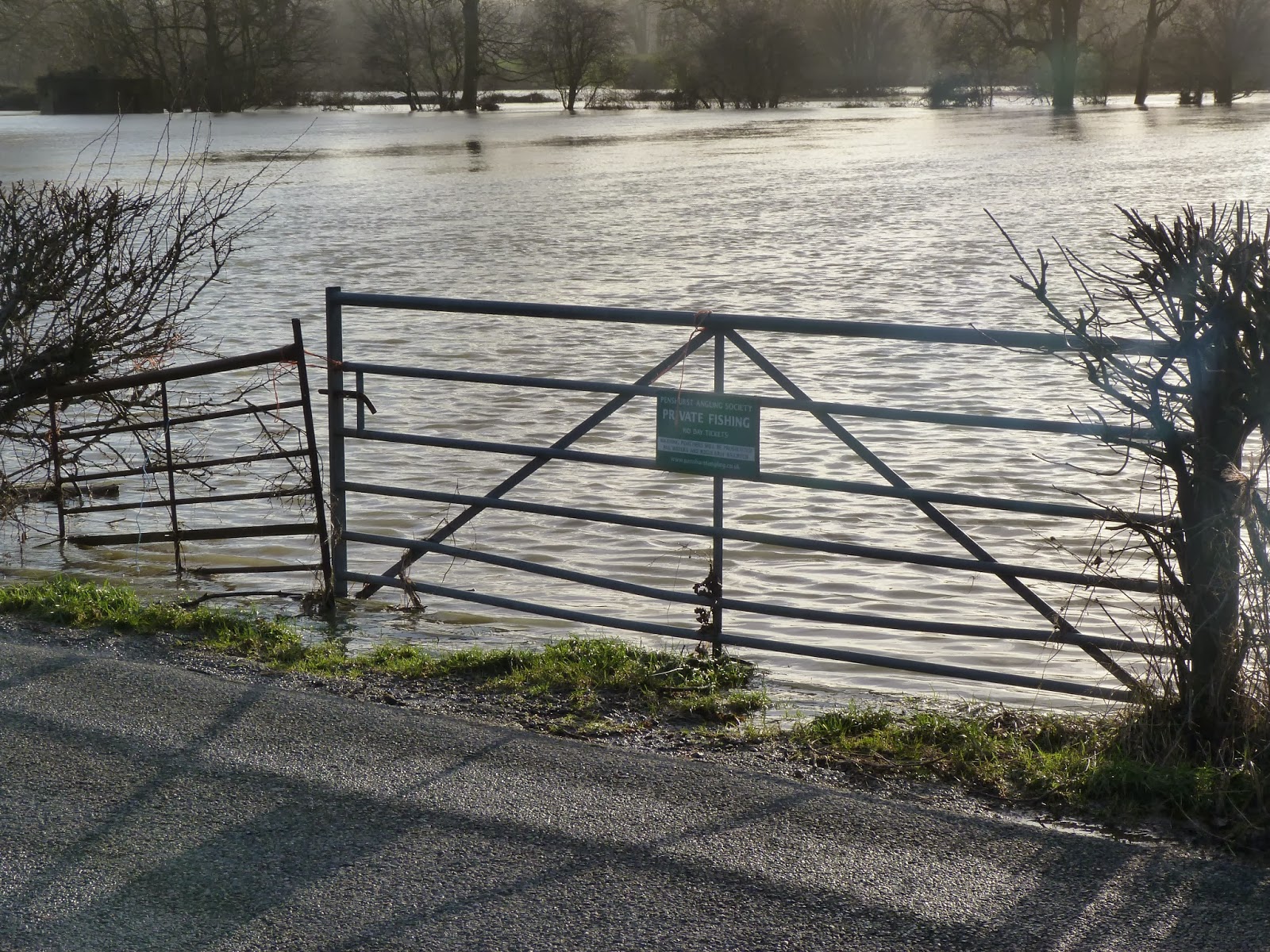
After heavy rain yesterday, the valley is a lake. A break in the weather today, thank goodness, and I went out with my camera to look at the levels. It's pretty, but with three more days of heavy rain and floods forecast, and the rivers at some of the highest levels ever recorded, the feeling in the village is one of trepidation. I took this photo standing on the road that was underwater on Christmas Eve. To the left, the Medway has burst its banks, and to the right, so has the stream that comes off the Eden.

The road is passable for now:


But it won't take much more rain for the water to start spilling over again:


With a bit of sunshine, it all looks deceptively picturesque:


Yet this is what the force of the flow did to the fence at the side of the road...

 
The damage is far greater downriver, where the poor people of Yalding and beyond have had a miserable time of it, their homes standing in feet of muddy water. Our flood water is at least controlled, even if the roads get sacrificed for a while: it is a holding bay for a flood barrier.
 
Our domestic flooding is a different matter, due to a silted-up drain on the main road into which run-off water pours down from a sizeable hill. This afternoon, if the local council cannot spare an unblocking team - and unbelievably, as it's on a public highway, they say they cannot allow a private company or indeed the water company to do it in their place! - we hope for sandbags as we dry out towels and sodden newspaper, and compare flood defences with our neighbours... 

Wednesday, 1 January 2014

Happy New Year 2014!

 
A very Happy New Year to all my loyal visitors to this blog. Thank you for all the inspiring comments. wise words, and encouragement - you make it all worthwhile.
 
"Happy New Year, Outlook Stormy" seems to be the general message here in England and throughout much of Europe, not only in weather terms but economically and politically. But in our village in Kent, the rainstorms have brought a reminder that kindness and neighbourliness go a long way to dispelling the gloom. At a time when we all read about fractured communities, it's quite something to realise, as a friend put it last night at a big riotous dinner party (within walking distance from home for all but two of the guests) that we could all knock at any door on the High Street and offer or ask for help. 
 
As the year begins, the rain is still falling steadily but it really is warm inside, despite the dripping and quirky leaks of our old houses, taking on water like ancient ships. 


Thursday, 26 December 2013

The storm that (almost) stole Christmas...

 
Belated greetings for the festive season from waterlogged Kent...it's been all hands to the pump (literally) since the incessant rain turned to a violent storm on December 23. At a quarter to midnight, friends in the village knocked on our door to say that we might want to move our car to higher ground as the water level was rising fast. It was then about six inches deep on our spot on the village high street.
 
By midnight I had had a light bulb moment, and was unblocking a drain grill in the road with a mop handle, wind howling all around, rain still lashing down. The water had already flowed into the next door property (only just refurbished) and when I went inside to find some spare wellies for our new neighbour, I found our basement had started to flood. A not-so-comical interlude followed in which The Panto King and I locked ourselves out and had to scream up to daughter on the top floor (sleeping through it all, as only teenagers can) to open the front door. But at least the drain was flowing again, swirling like a giant plughole.
 
I will draw a veil of the hours of mopping as we fought to keep the water away from our new wooden kitchen, though we had a stream into the dining room. Eventually, we were down to one persistent trickle of water coming into the passage outside the dining room. So, I sat there in front of it, mop and towels in hand, stemming the flow until 4.30am on Christmas Eve, until I was certain our flood defences would hold and our efforts would not be in vain.
 
But by 9am, the road was flooding again, but on the other side. I rushed out with trusty mop handle to try to find the drain across the way. But the water was too deep. Soon several of our other great neighbours were out helping, trying to find the drain and keep the water under control, but our village is in a deep valley, where the Medway and Eden rivers converge, and we soon realised that water was flowing down from a large sodden hill; all we could do was direct it into the one cleared drain.
 
Meanwhile, cars were finding the village a dead end, as the roads in and out were impassable, except for a few of the back ways. The current across here - the Medway is a tidal river - was quite frightening. On the left, the hedge and fence have disappeared.
 
 
And there was another important issue many of us were facing: the Great Christmas Eve Turkey Crisis. Many of us order our turkeys from the local farm shops, to be collected on Christmas Eve, and now there were large volumes of water between us and our free range Norfolk Blacks. As we looked up from our labours, there were striken expressions on the drivers of vehicles that had had to turn round (mostly because they'd ignored our warnings - amazing how people think that because they drive a 4x4 hazards don't apply to them). Eventually, Rob managed to collect our bird, only a couple of miles up the hill shown here, but the subject of a twenty-mile round trip.
 
Still, by the evening we were drying out inside, the turkey was stuffed, and the drinks party next door was fired by Christmas spirit. Battered and exhausted we may have been, but it was a timely reminder that we have a fantastic village community here. It was a Merry Christmas among friends after all, and we counted our blessings as we heard that Edenbridge to the west, and Tonbridge and Maidstone to the east (and towns and villages all over the south of England) were underwater after the rivers broke their banks there too.

Saturday, 21 December 2013

Gwen Raverat's Trinity Bridge

 
So many hits on the previous blog post about Gwen Raverat's childhood home and memoir Period Piece - thanks to a mention on the superb Cornflower Books - that I thought I'd put up a second part. Here's Gwen Raverat's print dated 1937 from a wood engraving of Trinity Bridge. Downriver from Newnham Grange, Trinity is the grandest college in Cambridge; her grandfather Charles Darwin studied here, and her father George was a Fellow. But the following extract from Period Piece tells you all you need to know about Gwen the iconoclast. (And what makes her book so entertaining.)
 
My mother took to [Newnham Grange, a house with a granary right on the river] with enthusiasm; which was characteristically brave of her; for most mothers would have thought the situation damp, and the river both dangerous and smelly.
 
And so it was; I can remember the smell very well, for all the sewage went into the river, till the town was at last properly drained, when I was about ten years old. There is a tale of Queen Victoria being shown over Trinity by the Master, Dr Whewell, and saying, as she looked down over the bridge: 'What are all those pieces of paper floating down the river?' To which, with great presence of mind, he replied: 'Those, ma'am, are notices that bathing is forbidden.' 

Raverat's depiction of Trinity Bridge, with the Wren Library in the background, is the view from the riverbank reserved for College members - a spot I came to know very well (and still feel a pang when I see it) when I had rooms in New Court opposite in both my first and third years as a student. Here's my photo of the edge of the great library the other week - note the same winter branches.


This is the view from the bridge, much sanitised since Queen Victoria's day - the modern (-ish) Garret Hostel Bridge eclipses Clare Bridge behind. I rather like the capture of the three Cambridge modes of transport: bicycle, punt and foot (cars being more trouble than they are worth in the labyrinthine one-way system around the pedestrianized town centre).


Here is the majestic Wren Library from inside Trinity, at the west end of Neville's Court...


...with the misty river beyond...

 
For more information about Gwen Raverat, I can recommend Frances Spalding's excellent biography, and the Raverat Archive blog, run by her grandson William Pryor, which also offers prints of her work for sale. 

And finally, some atmospheric music from the Choir of Trinity College, to go with the pictures:

Tuesday, 17 December 2013

Gwen Raverat's Cambridge

 
I happened to be in Cambridge again last week, in the soft blue-grey mists of winter that blur the present into the past. Down Silver Street and over the bridge, the river scene is little changed not only from my memory of it, but from the way it is depicted in Gwen Raverat's illustrated book, Period Piece.
 
It first came my way when I was thirteen, at school in London - an English class text. First published in 1952, it's a charming memoir of Raverat's childhood in Cambridge as part of the influential Darwin family: Charles Darwin was her grandfather. When I first read it, all the interest seemed to lie in the often hilarious depictions of Victorian life, the odd proprieties that had to be observed, especially in love and courtship. The characters are larger than life: Gwen's American mother Maud du Puy of Philadelphia, who arrived in Cambridge to stay with an aunt in the summer of 1883 and accepted the proposal of Darwin's second son, George, a fellow of Trinity College; eccentric hypochondriac Aunt Etty invents her own anti-cold mask that gives her a beak like a cross bird. Young Gwen never forgets seeing a party of undergraduates running up from the river and into The Anchor pub carrying what looks like the dead body of a young woman.
 
It's a warm, enticing read, full of dry humour and acerbic wit and wisdom as the Gwen who is now in her sixties recalls the child's world she once inhabited. Throughout the book are Raverat's own line drawings, giving vivid impressions, full of detail, of both people and her surroundings. At the time I first read it, I don't remember being particularly interested in the lovely setting. I had never visited Cambridge at that stage so it didn't mean a great deal. It was only later, as so often, that I read it again as a student there and took pleasure in placing events in their true context.
 
The family house, Newnham Grange, with its exciting-looking granary on the river, is now part of Darwin College. Here's her illustration, with the present-day view below:


What I find really interesting is that the illustration is not architecturally accurate, and it differs in a way that is unlikely to be due to renovation of the building. This is a place Gwen Raverat knew well all her life. It was her last home, as well as her first. It seems more likely that she drew the granary from memory, and that memory focused on the set pieces like the Romeo and Juliet window and the door onto the river. In a way, it's also an illustration of how we remember places and events: imperfectly and individually.
 
When I was about nine the granary became so dilapidated that something had to be done about it; so my mother had the idea of turning it into a flat, or upstairs house, and letting it. Then for a long time, we had glorious fun with scaffolding rising up out of the river, and ladders, and mortar, and workmen, and mess. (...) The house is most ingeniously full of my mother's beloved gadgets: tricks for opening the front door without going downstairs, and for drawing up the bread in a basket; though, of course, the architect insisted on following the well-known Victorian principles of making the dining-room as far as possible from the kitchen, and the bathroom as far as possible from the hot-water boiler. This particular architect was quite explicit about it: he wrote a book on house design, in which he said: "The coal store should be placed as far as possible from the kitchen, in order to induce economy in the use of fuel."      
                                                                 from Period Piece  
 
The book ends with Gwen a young woman in London, studying art at the Slade School; she went on to become a renowned wood engraver and illustrator. She was a great friend of the poet Rupert Brooke and married French painter Jacques Raverat in 1911. Both part of the Bloomsbury group, they lived in the South of France, in Vence, until Jacques' death from multiple sclerosis in 1925. The couple had two daughters. Gwen returned to Cambridge, moving into The Old Granary in 1946 and remaining there until her death in1957.
 
 
Gwen Raverat, self-portrait

Related Posts Plugin for WordPress, Blogger...